- General
- Our Engagements
From Ideas and Dreams on Paper to Panels on the Roof
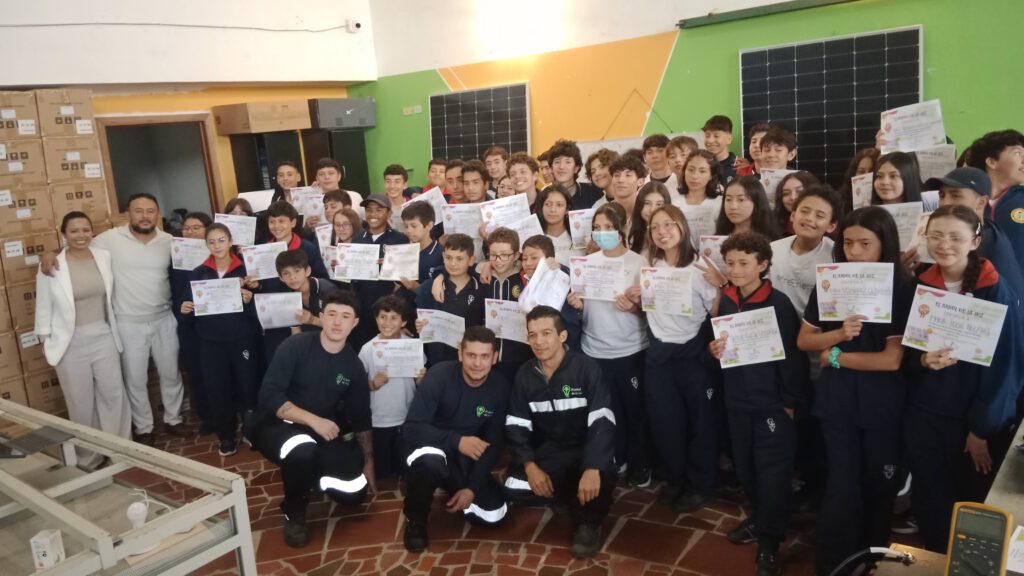
What seemed like a distant goal back in December 2024 is now reality: on the rooftops of Colegio Fervan Campestre, 40 solar modules are turning back the meters. A year that began with dreams on paper ended with 24.8 kWp installed on the school’s roof. And more than that: with students who understand how it works – and why it matters.
Teacher Martha Medina accompanied the 2025 school year as project lead and sums it up like this: a year full of learning moments, full of challenges – and in the end, full of pride.
The Courage to Try Something New
The 2025 school year began for Colegio Fervan Campestre with a clear decision: solar energy would become the defining project theme of the year – not as a side topic, but as a common thread running through all subjects. That was no small step. For a teaching staff that had barely touched topics like photovoltaics in their own disciplines before, it meant charting new territory. The first and perhaps most important step was the curriculum work with the freEnergy team during the planning week before school started. Teachers from physics, chemistry, biology, technology
and other subjects examined together: What is already there? What needs to be added? Which topics belong to us? The result was surprising: many curriculum topics – from the physical fundamentals of solar radiation to basic electrical engineering – were already anchored in the Malla Curricular. What changed was not the subject matter, but the focus and the connections between disciplines. Cross-subject thinking, embedded in a shared context: the power of the sun.
STEAM as the Heart of the Project
For Grade 10, solar energy became the centrepiece of the newly introduced STEAM class. An elective was also created for Grades 6 to 9 – a total of 44 students immersed themselves in the world of photovoltaics. In this space – a learning environment beyond the conventional classroom – something special happened: students worked on real projects. They analysed sites, calculated energy needs, compared storage technologies and developed financing models. They used design thinking methods to understand problems from different perspectives – and the Business Canvas model to
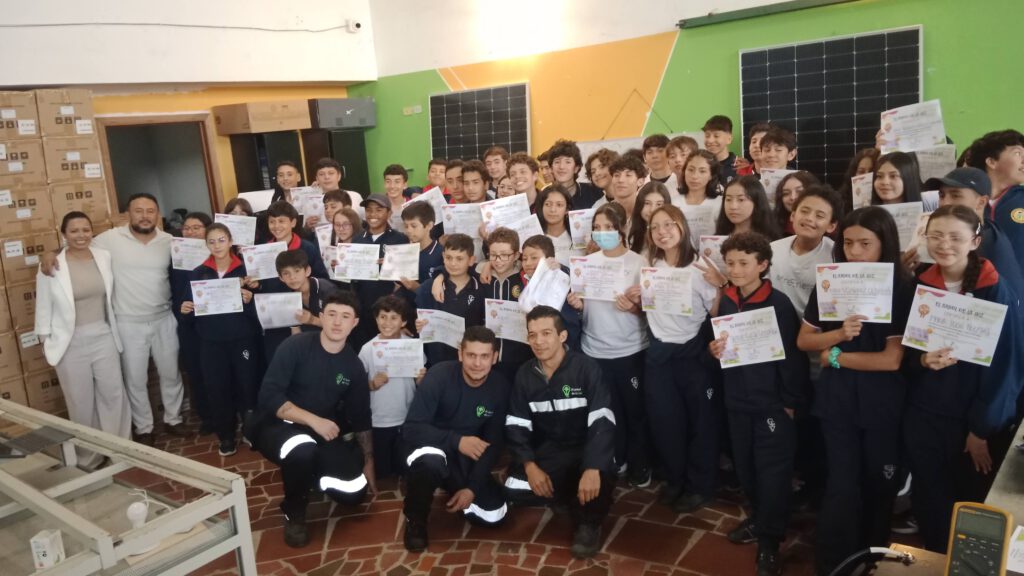
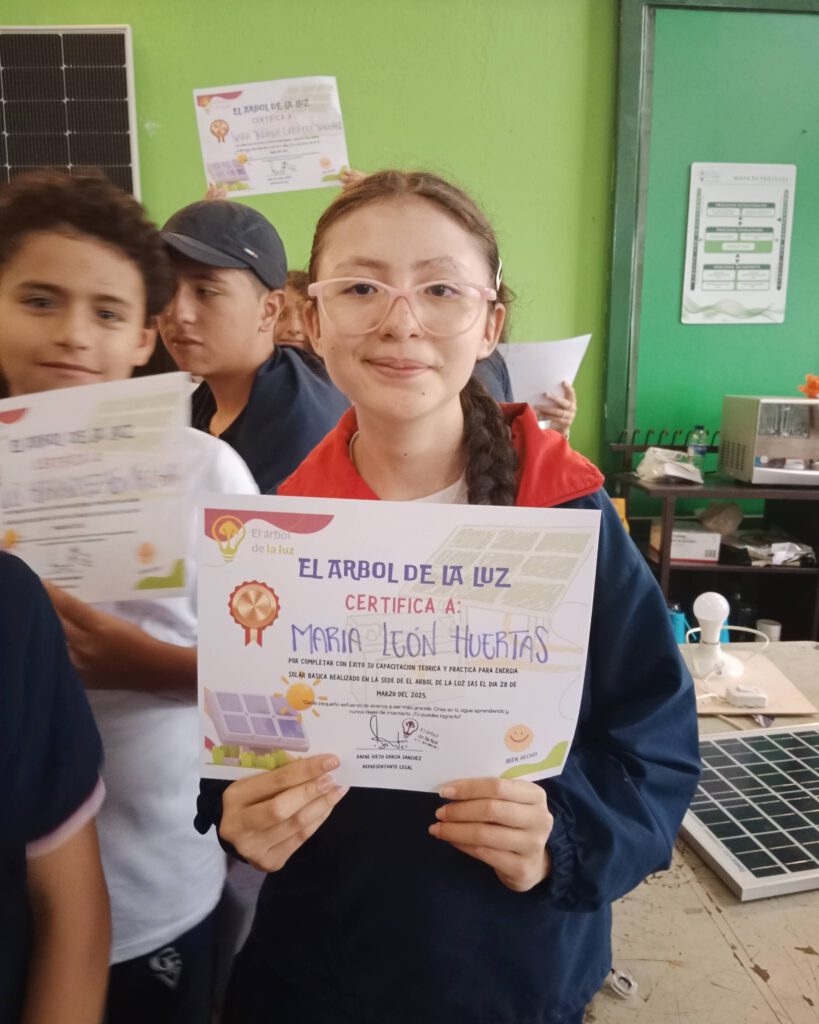
make solution ideas tangible. They were also accompanied by partners from practice: the company El Arbol de la Luz delivered four workshops at the school, parents rought their professional experience, and the freEnergy project team was regularly on hand as a sparring partner.
Beat the Experts – the Core of the Project
The “Beat the Experts” competition gave the project year its framework and its drive. The goal: by the end of the year, students should be able to plan the photovoltaic installation for their own school independently – and ideally outperform the experts.
That is no small ambition. And that is precisely where the strength of the format lay. Real competition emerged – but so did real motivation to learn. The students knew: this is not an exercise sheet. This is the planning of their own school.
A Closing Event to Remember
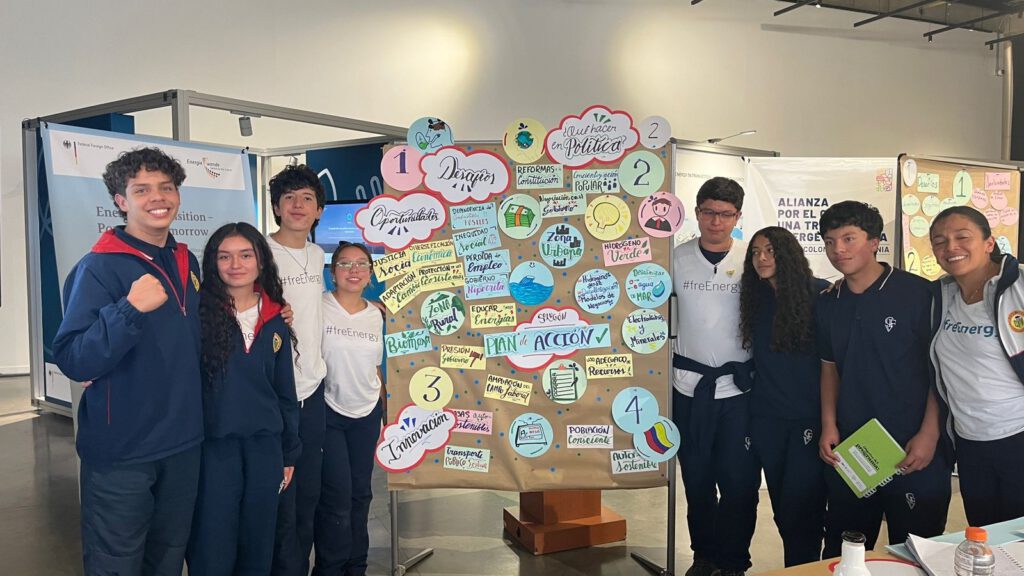
On 8 November 2025, the project presentation took place – and it became a true event. Seven teams presented their plans and concepts to eight jury members: engineers, entrepreneurs, researchers and specialists from fields including electronics, environmental engineering and biochemistry. Parents, school management and teachers also attended. Martha Medina opened the day with words that captured the spirit of the project perfectly:
“This process was far more than an academic experience. It was a journey of discovery, creativity and awareness of the importance of clean energy for the future of our planet.”
The event opened with a guest lecture by Dr Abigail Gonzalez Diaz (University of Edinburgh) on green hydrogen as a climate protection option – a preview of possible follow-up projects in 2026.
Then came the students. Seven teams, four members each, presented their projects. Prizes were awarded – from a motor tool set for the winning team (Lisbeth Ruiz, Joaquin Caicedo, Sara Rey, Samuel Morales) to electronics vouchers and solar-powered robot kits for everyone. But the real reward was something else: the chance to hold their own in front of genuine experts and know – we did this ourselves.
What Is on the Roof
Alongside the learning journey in the classroom, the real project was taking shape. A grid-connected photovoltaic system was installed on the roof of Colegio Fervan Campestre:
- 40 bifacial solar modules (JA Solar JAM66D45-620/LB), each 620 Wp
- Total installed capacity: 24.8 kWp
- Inverter: GoodWe GW20KLV-MT, 20 kW, three-phase
- Three strings with 14, 13 and 13 modules
- Bidirectional metering, monitoring and full surge protection
What was still a sketch in December 2024 is now a functioning system. The school saves on electricity, uses solar energy – and has a living learning laboratory right on its own roof.
What Remains – and What Comes Next
Colegio Fervan Campestre keeps dreaming. The school aims to establish a STEAM laboratory by the end of 2026, enabling ongoing experimentation and learning around renewable energies. The ambition is clear: the students’ knowledge should be certified – so that what they have learned does not stay in the classroom, but opens real doors. And what has the project year shown from the freEnergy team’s perspective? That it works. That a structured curriculum, committed teachers, genuine partners and a clear goal can together set something in motion that is greater than the sum of its parts.
What was written on paper in December 2024 is generating electricity on the
roof today.
Want to start a similar project at your school or organisation? We are happy to share the curriculum and planning materials. Write to us: info@fre.energy
Impressions