- Our Engagements
From concept to execution
Armed with the curriculum content and the concept, we were able to tackle the next steps together with Monica and Martha from Colegio Fervan. The key questions were how to structure the knowledge transfer and what the practical component for the students should look like.
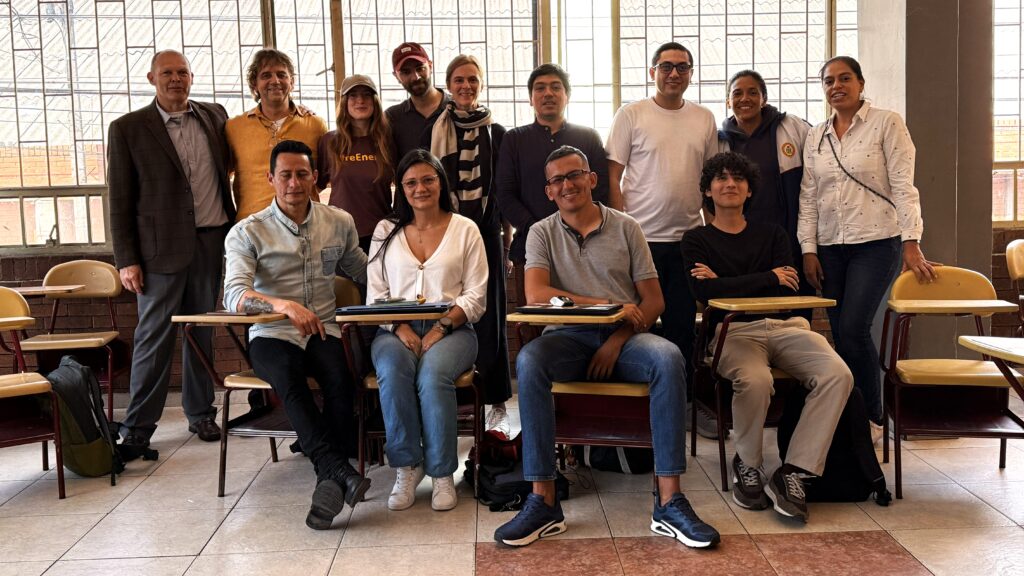
The beginning of the school year proved to be the ideal time for the knowledge transfer to the faculty. During the planning days in the week before classes started, we held on-site workshops to discuss the curriculum with the teachers (see image). The goal was to present and discuss the technical know-how and pedagogical considerations. Subject teachers from physics, mathematics, technology, and economics reviewed the extent to which these topics were already covered in their classes and coordinated across departments to identify which content needed more focus. By the end of the week, every teacher had a solid roadmap for their respective subjects for grades 5 to 11.
In parallel, a PV (photovoltaics) project was launched for the school year to link theoretical content directly with practical application. Over the course of ten months, students are to be empowered to plan a PV system independently.
Beat the Experts
Together with Martha, the head of the PV project, we moved straight into detailed planning following the initial planning week. Our goal: to enable students to build their knowledge step-by-step and effectively combine theory and practice, so that by the end of the year, they would be able to independently plan the school’s PV system. The content was structured and distributed across the period from February to September (see graphic). This foundation allowed Martha to dive into in-depth planning and develop her own approach to delivering the individual modules. One thing is for sure—Martha did an outstanding job. It was impressive to see how she brought the different age groups together and managed to spark genuine enthusiasm for the subject.
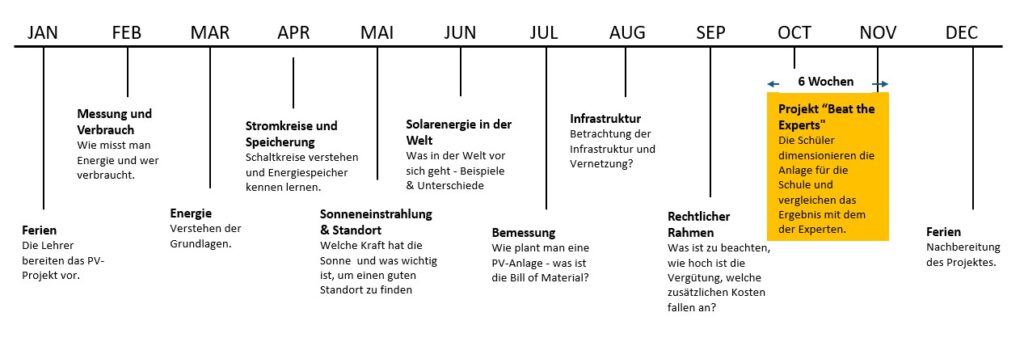
To increase student engagement, the “Beat the Experts Challenge” was launched. At the end of the project, students were tasked with independently designing the school’s PV system. They were explicitly encouraged to come up with a better configuration than the experts themselves. Once the students submitted their planning documents, the experts’ own design served as the benchmark for comparison.
A Checklist for Planning a PV System
For the expert design phase, we developed a detailed checklist (see graphic) that consolidates all the questions required for the system’s configuration. It is organized into five core areas: location, solar radiation, power consumption, legal framework and services, and the sizing section.

Originally conceived as a support tool for Martha and her student project, we first used this checklist ourselves to efficiently determine the necessary data and work through the planning in a structured manner. The fully completed checklist thus serves as the reference base for the subsequent comparison with the students’ results. Furthermore, it serves as an excellent blueprint for future projects—full documentation is available upon request.
